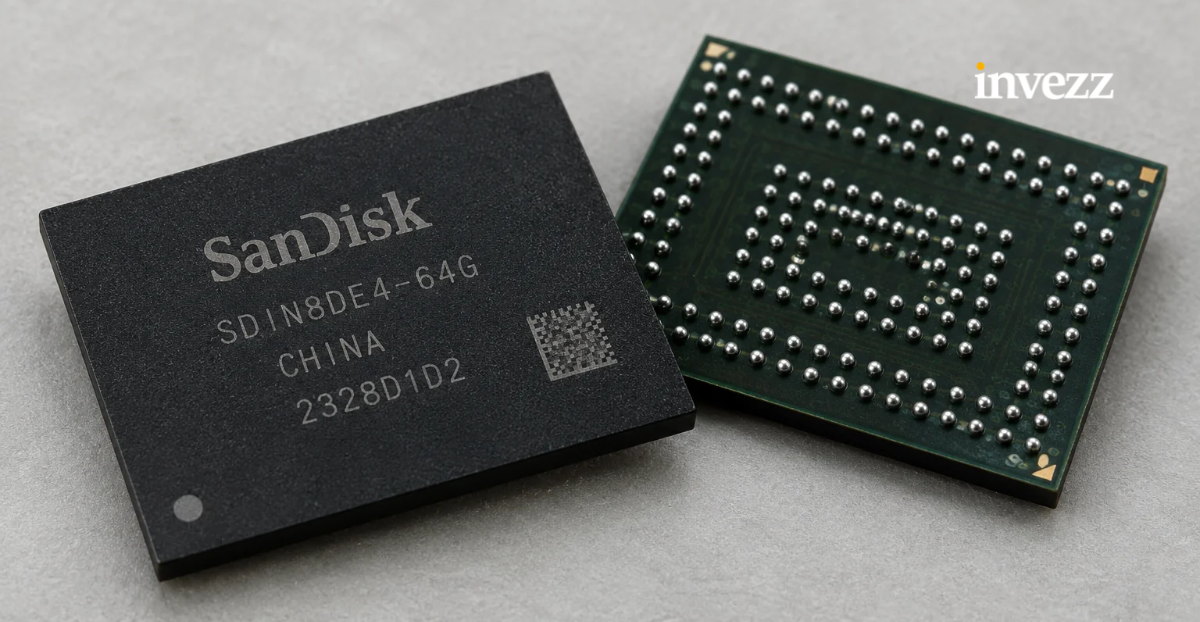
SanDisk stock (NASDAQ: SNDK) is heading towards an eight-for-one stock split after losing nearly 65% of their value since June, as investors question whether the memory-chip maker can sustain its profit margins.
The stock closed Monday at $809.11, down 8.58%, against a record closing price of $2,335 on 25 June.
The sell-off contrasts with SanDisk’s latest results, which showed quarterly revenue surging 378% and gross margins reaching 85%.
The split takes effect this week, but the bigger concern is that SanDisk’s earnings boom has depended heavily on rising NAND flash prices.
Why the SanDisk stock split will not reverse slide
SanDisk will issue seven additional shares for each existing share after Thursday’s market close, with split-adjusted trading beginning on Friday, 20 November.
The change makes each share cheaper to purchase without altering the value of an investor’s holding or the company’s market capitalisation.
It cannot improve future cash flow or reduce exposure to the memory industry’s recurring pricing cycles.
At Monday’s closing price, an eight-for-one adjustment would produce an indicative share price of about $101.14. Someone holding one share would instead hold eight, with the same combined value before market movements.
SanDisk announced the split on 29 October, partly to make shares more accessible through employee ownership programmes.
But the lower sticker price cannot resolve uncertainty surrounding memory-chip demand, AI infrastructure spending or the durability of high selling prices.
Daniel Sparks, an investor and chief investment officer at Sparks Capital Management, wrote in The Motley Fool that concerns about the decline made sense for a business whose recent growth had come “almost entirely from price”.
SanDisk stock: A 378% revenue surge conceals a pricing problem
SanDisk generated $11.03 billion in revenue during its fiscal first quarter, compared with $2.31 billion a year earlier.
Yet the volume of storage shipped, measured in exabytes, increased by almost 10%, according to the company’s regulatory filing.
Data-centre revenue reached $4.8 billion, up 61% sequentially, reflecting demand for storage infrastructure supporting artificial intelligence.
In its Edge division, revenue per gigabyte jumped more than 450% even as shipment volumes fell 20%. Rising prices therefore accounted for much of the dramatic sales growth.
Gross margins climbed to 85% from 29.8% a year earlier. Such profitability is attractive, but also exposes SanDisk to sharp reversals if manufacturers expand capacity or customers push back against prices.
There is a counterargument. SanDisk’s longer-term customer agreements create clearer revenue commitments, with $88.9 billion in remaining performance obligations reported at the quarter’s end.
Evercore ISI analyst Amit Daryanani told MarketWatch that investors remain “overly focused on how long NAND pricing can stay elevated” rather than appreciating structural changes, including supply discipline and multiyear contracts. He maintained an Outperform rating and $2,500 price target.
Can NAND prices hold up through the next cycle?
SanDisk expects second-quarter revenue of $12.2 billion to $12.6 billion, implying roughly 12% sequential growth at the midpoint, slower than the previous quarter’s 23% expansion.
Its non-GAAP gross-margin forecast of 84.5% to 85.5% nevertheless suggests management expects pricing conditions to remain favourable near term.
Manufacturing partner Kioxia anticipates more moderate NAND price increases this quarter, while forecasting tight supply through 2027.
Morningstar analyst William Kerwin is less convinced the gains can last. “We still expect a severe downcycle after the peak,” he wrote, cutting SanDisk’s fair value estimate to $870 from $1,000.
Morningstar expects additional industry capacity to pressure prices from 2029, with weakness continuing through 2031. If prices turn sooner, profits could fall even as physical shipment volumes remain stable.
The post SanDisk stock faces 8-for-1 split after 65% crash, but a bigger risk looms appeared first on Invezz